Portfolio

Projects

The portfolio is grouped by kind of work rather than by rank: applied systems, research projects, and interactive explainers or earlier experiments that still matter for lineage.

Applied Systems

Product-shaped systems and workbenches built around real workflows, explicit evaluation, and operational constraints.

Aegis system view for document parsing, retrieval, and recommendation drafting.
Applied Systems

Document Intelligence + Insurance AI2026

Aegis

Research Prototype

Open page

Underwriting teams receive messy, multi-format claim packs. The goal is to convert those artifacts into an auditable, typed case summary with linked evidence so reviewers can reason faster and more consistently.

Problem

Scanned PDFs, photos, and dashboard screenshots resist search and comparison, and rarely map cleanly to policy clauses. This creates manual re-keying, fragmented provenance, and variability in how similar cases are assessed.

Approach

Action: a modular intake pipeline that chains OCR (DeepSeek), visual reasoning (Qwen3‑VL), local retrieval over uploaded artifacts, and a typed report generator. The Next.js app exposes both mock and live paths so the end-to-end flow is reproducible in demos and safe without external credentials.

Impact

  • Produces a structured, citation-rich memo with links back to the original artifacts for auditability.
  • Reduces copy-paste by normalizing extracted facts into a typed schema that downstream tools can consume.
  • Pairs naturally with ParaEval: Aegis extracts and justifies evidence; ParaEval adjudicates formal trigger decisions.
DeepSeek OCRQwen3-VLRAGOpenRouterUnderwritingNext.js
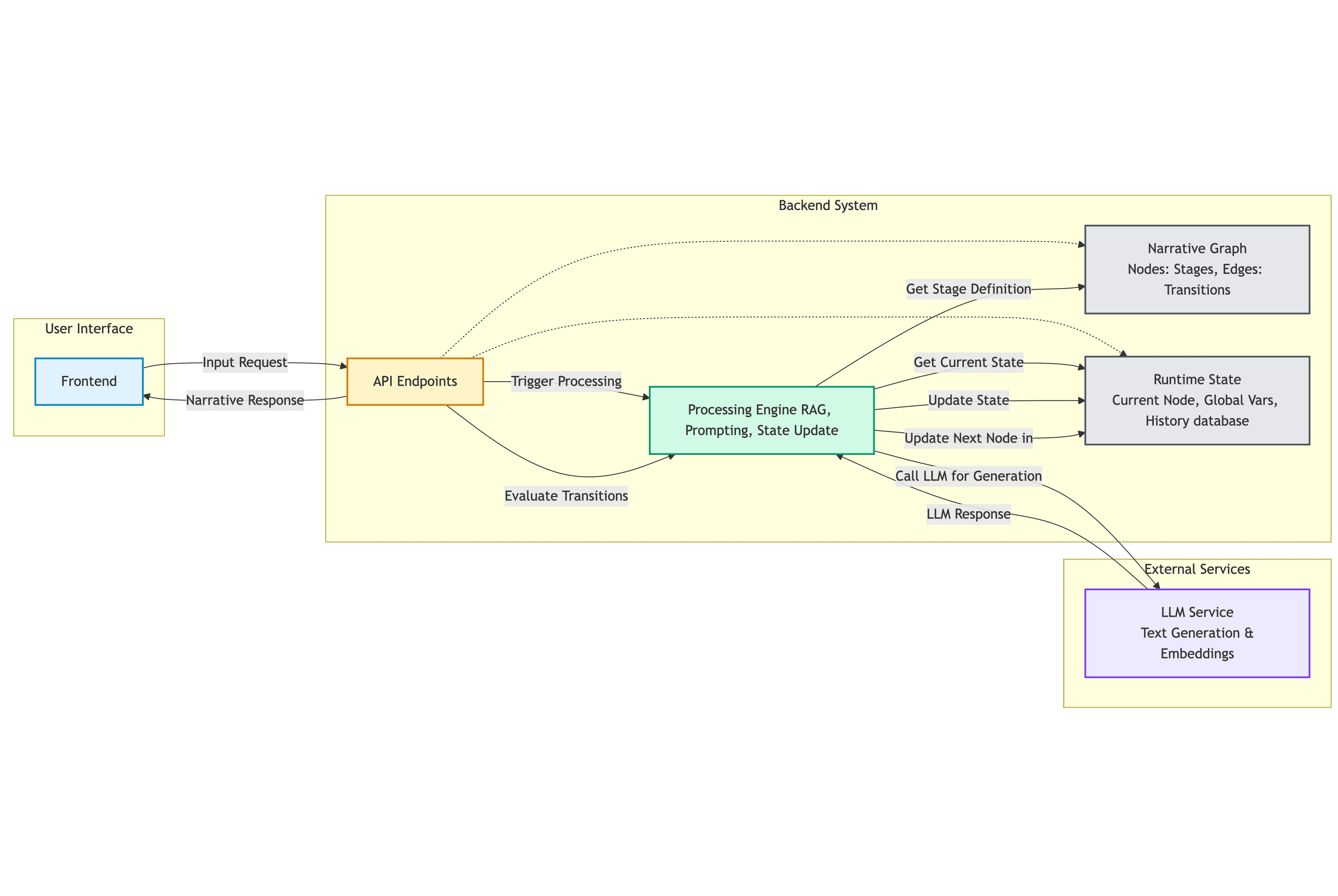
Orchid v2 system view for deck, stage, and runtime orchestration.
Applied Systems

Generative Narrative Systems2026

Orchid v2

Operational Prototype

Demo

A narrative authoring runtime that turns Orchid from a research concept into an operational tool: card decks, stage boards, prompt inspection, and admin controls in one coherent workspace.

Problem

Narrative AI tools often stop at playful generation. They rarely give authors a real production surface for structuring worlds, inspecting prompt/runtime behavior, and managing story state as a system.

Approach

Action: evolve the original Orchid card-and-graph idea into a multi-surface workbench with deck creation, stage orchestration, LLM/runtime inspection, JSON import-export, and admin settings for deployment defaults.

Impact

  • Repositions Orchid as a credible product system rather than only a paper prototype.
  • Makes the authoring pipeline legible: writers can move from world ingredients to stage logic to prompt/runtime debugging in one place.
  • Creates a stronger portfolio bridge from earlier interactive narrative research to current operational AI product work.
Narrative RuntimeAuthoring ToolsLLM SystemsPrompt OpsReactSystem Design
ParaEval case review showing evidence sources and trigger decision.
Applied Systems

Parametric Insurance + AI Evaluation2025

ParaEval

Research Prototype

Open page

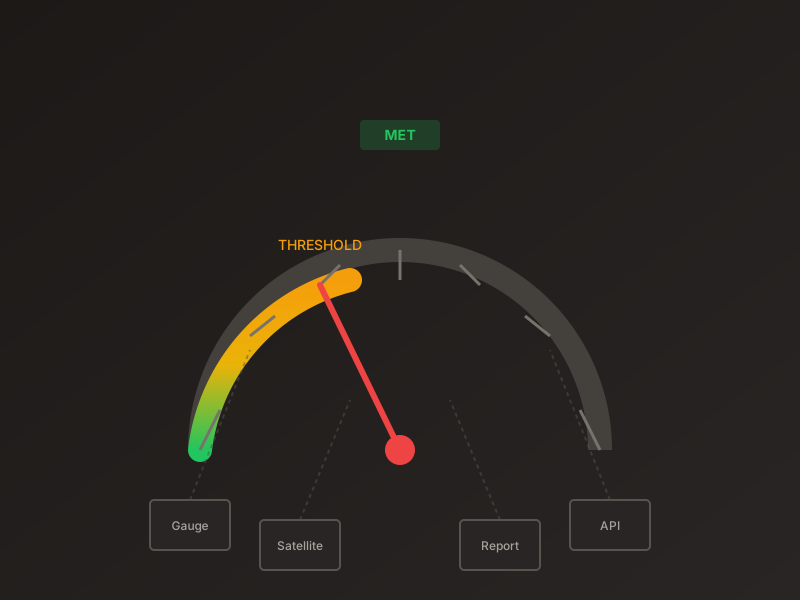
A workbench to adjudicate parametric trigger decisions against multi-source evidence. It makes the decision path explicit and expandable so reviewers can trace Situation → Task → Action → Result for each case.

Problem

Policies trigger on index values (gauges, satellite, APIs) rather than on verified loss. Near-threshold disagreements across sources create ambiguity and hidden basis risk without a shared reasoning frame.

Approach

Action: normalize heterogeneous sources, apply a deterministic decision algorithm, surface disagreement as first-class basis risk, and regression-test the engine against golden cases. The contract layer (Zod) mirrors future Pydantic models for a clean TS⇄Python bridge.

Impact

  • Transparent rule-trace and narrative output suitable for review memos and audits.
  • Explicit basis-risk classification highlights why sources diverge and how that affects confidence.
  • 31 unit tests cover algorithm branches to prevent silent regressions as cases and rules evolve.
Parametric InsuranceZodSQLiteLLM ExtractionEvaluationNext.js

Research Projects

User-facing research prototypes and installations that informed the later system work.

SeaSense user interface for writing emotion prompts.
Research Projects

Generative AI + Wellbeing2024

SeaSense

Deployed Installation

Demo

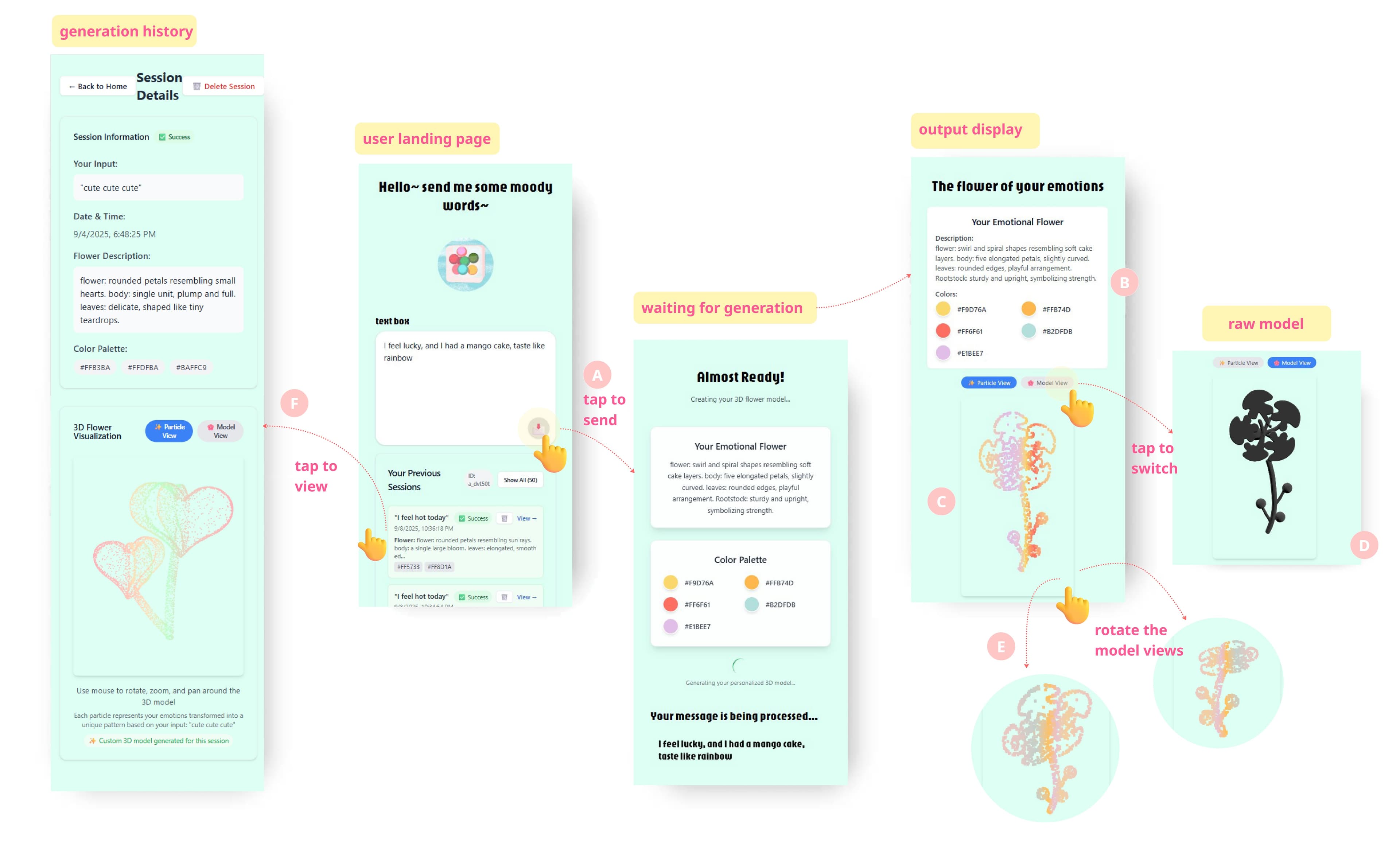
Public spaces rarely invite slow, shared reflection. The task was to turn ordinary text about feelings into a collective, ambient visualization people could contribute to on the spot.

Problem

Emotion tech often collapses nuance into fixed labels, discouraging participation and limiting personal resonance in public settings.

Approach

Action: use an LLM to interpret free‑text emotions and drive a 3D flower generation pipeline in Unity. Add gentle guardrails for privacy/moderation and a phone‑friendly input flow for walk‑up participation.

Impact

  • Week‑long deployment with 300+ contributions created a continuously evolving garden.
  • Follow‑up interviews indicated increased curiosity and deeper reflective engagement.
  • Operational playbook for on‑site setup, moderation, and teardown is now repeatable.
GenAIEmotion AI3D PipelineUnityHuman-Computer Interaction
HK-GenSpeech example image collage for prompting participants.
Research Projects

Healthcare AI + Speech2023

AlzDetect (HK-GenSpeech)

Research Prototype

Demo

Early cognitive screening works better when it feels conversational and culturally local. The task was to open the doorway: keep rigor while inviting richer speech.

Problem

One‑size prompts constrain expression, create fatigue, and miss culturally specific cues that matter for clinical interpretation.

Approach

Action: generate localized image prompts and model speech with Wav2Vec2 to derive cognitive indicators. Collect a new Cantonese dataset and compare reliability/error against conventional baselines.

Impact

  • 423 descriptions from 141 Cantonese speakers (55–94) established a local evidence base.
  • AI‑generated prompts matched baseline reliability while mixed stimuli reduced prediction error.
  • Pointed to next steps: longitudinal tracking and fair‑ness checks across demographics.
Speech AIWav2Vec2Clinical NLPEvaluationGenAI

Explainers And Earlier Work

Interactive explainers and earlier systems that still matter as part of the broader technical arc.

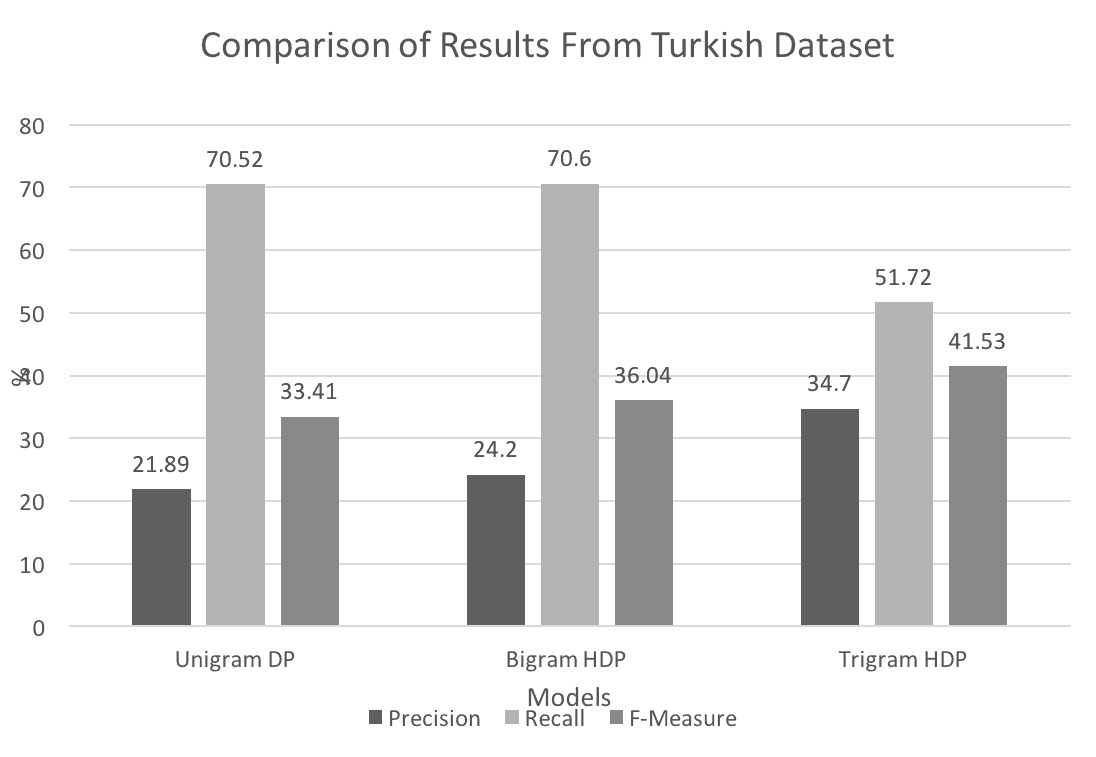
Turkish segmentation benchmark chart used in the MorphoSeg CRP/HDP explorer.
Explainers And Earlier Work

Bayesian NLP Education2026

MorphoSeg CRP/HDP Explorer

Interactive Explainer

Open page

Students and practitioners struggle to build intuition for CRP/HDP morphology. The task is to make the abstract process tangible and testable so people can connect symbols to outcomes.

Problem

Without an interactive mental model, reuse vs. novelty, concentration parameters, and segmentation quality feel like disconnected equations rather than one system.

Approach

Action: animate the CRP/HDP generative story (reuse vs. novelty) and pair it with runnable train/test experiments on English, Finnish, and Turkish datasets so users can tune priors and observe effects.

Impact

  • Moves from metaphor to measurable results in one place (no context‑switching).
  • Reduces ramp‑up time by letting users observe how priors change segmentation quality.
  • Bridges paper‑level theory and reproducible interaction in the same learning flow.
Dirichlet ProcessHDPMorphological SegmentationEvaluationInteractive
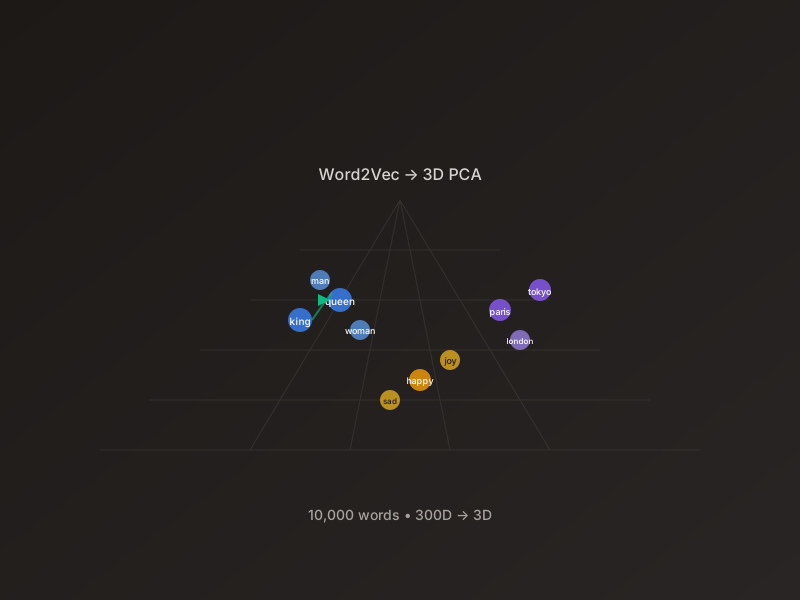
Interactive 3D view of the 10,000 word dataset.
Explainers And Earlier Work

NLP Visualization2026

Word Embedding Explorer

Interactive Explainer

Open page

An interactive 3D explorable that turns embedding math into spatial intuition. Visitors can fly through clusters and watch familiar analogies line up in space.

Problem

300‑D embeddings are powerful but opaque; it is hard to build intuition for neighborhoods, axes, and analogies from numbers alone.

Approach

Action: reduce 300‑D Word2Vec vectors to 3D via PCA, then render an efficient Three.js scene with labeled clusters and vector hints (e.g., king − man + woman → queen).

Impact

  • Reveals countries, capitals, emotions, and tools as stable spatial groupings.
  • Shows classic analogy vectors directly in the scene to connect equations with perception.
NLPWord2VecThree.jsDimensionality ReductionInteractive
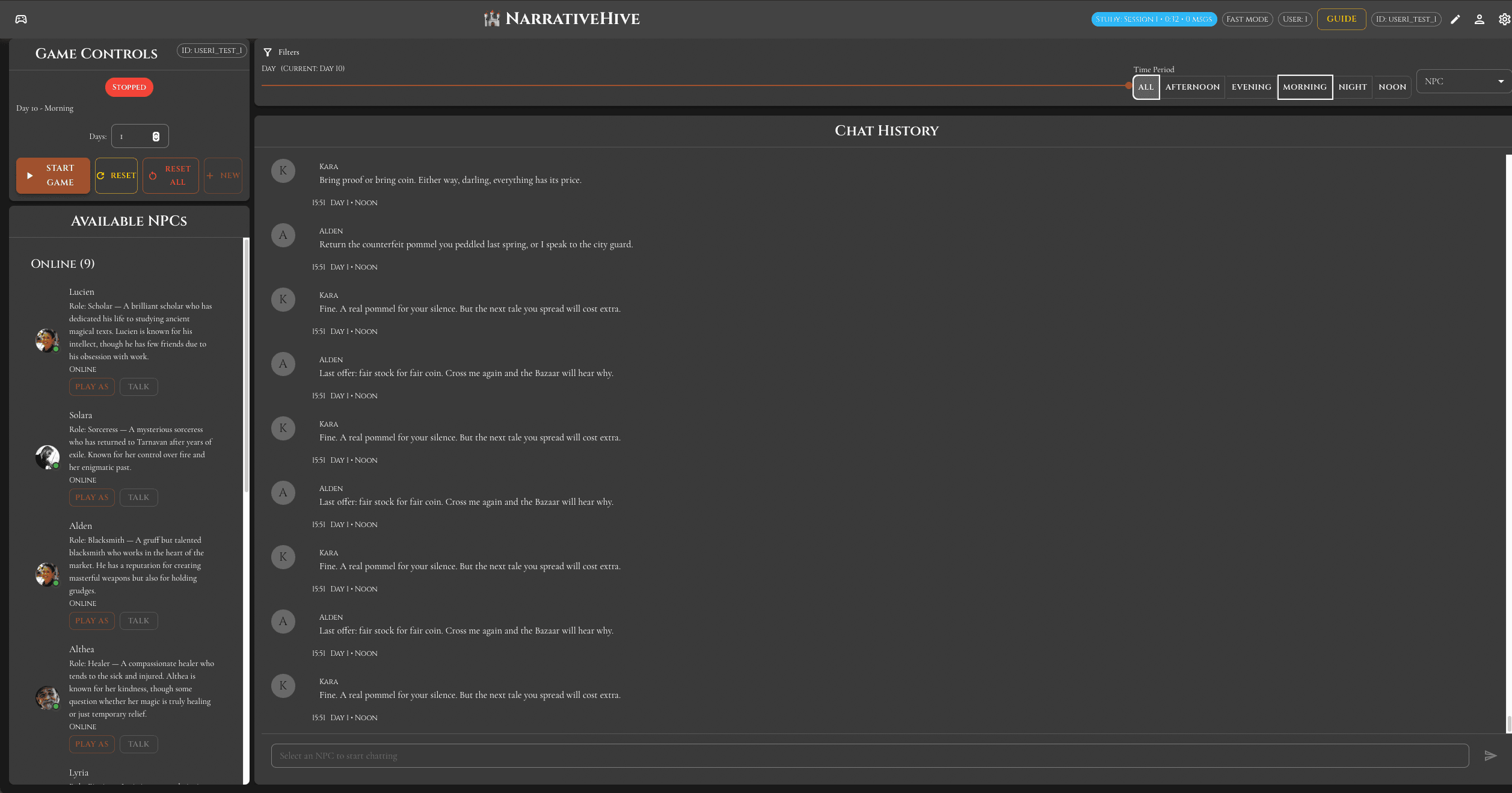
Narrative Hive main screen with timeline and controls.
Explainers And Earlier Work

Multi-Agent Systems + Storytelling2021

Narrative Hive

Research Prototype

Demo

Group storytelling with AI collapses without shared memory and social logic. The task: let humans and agents improvise together while the world stays coherent.

Problem

When improvisation outruns memory and governance, characters forget, norms erode, and continuity breaks ruin the experience.

Approach

Action: model the world like a small society—lifecycle, scheduling, memory, and reputation agents beneath an LLM dialogue layer—so play remains believable at human tempo on commodity hardware.

Impact

  • Reputation signals increased perceived naturalness and trust in controlled comparisons.
  • Sustained engagement from casual play up to 100+ turns/session demonstrates stability.
Multi-AgentLLMRAG/MemoryGame SystemsEvaluation